A Day in Dornoch
Among Too Few
Royal Dornoch Golf Club
Dornoch, Scotland
Greens fee: £280
Date played: October 8, 2024
“I know I’ve seen this place before
Lord, can’t you hear me screaming?
As a young man long ago
When I was twenty-one.”
- Lyle Lovett, “Baltimore”
Dornoch was right where I’d left it.
Eight years earlier, on a grey July morning, I’d boarded a Stagecoach bus at the Dornoch bus stop on my way to Troon. It had been my first visit to Scotland, and the day and a half in Dornoch had been my only glimpse of the Highlands. But eight years later, when I began sketching out a return trip, Dornoch and the Highlands immediately came top of mind. Of the places I’d seen on that first trip, only Dornoch had felt like home.
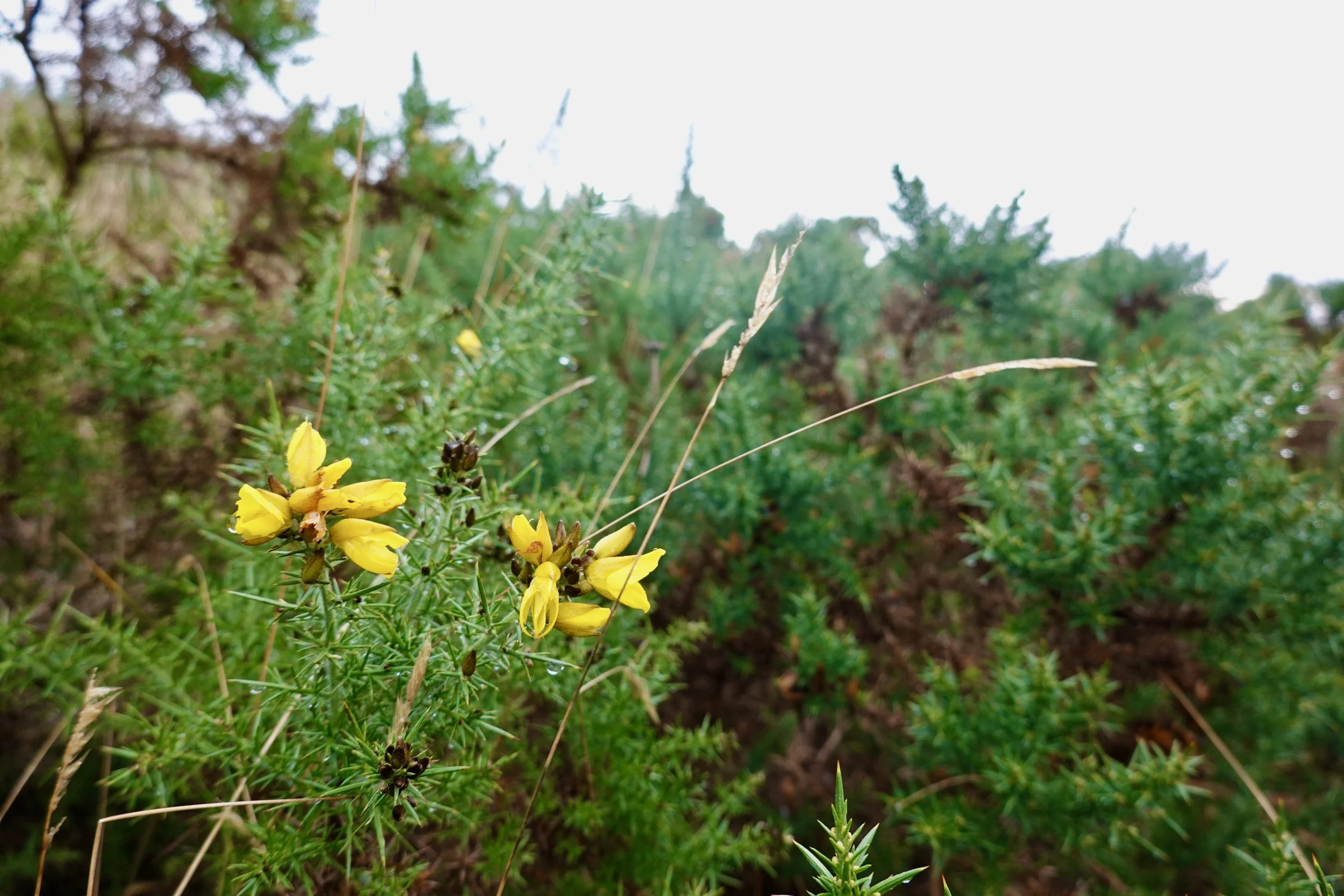
Gorse blooms holding fast in the scrubby links between Dornoch Beach and the golf course.
Here I was again, then — but this time, stepping off the bus and back into Cathedral Square, at the same bus stop, in the center of the venerable old town. It was morning again, and still overcast. But the rain from Brora the day before had blown out, leaving behind only a stiff breeze.
People have been coming to Dornoch for a lot longer than the bus has let out there. Scots have called Dornoch home since at least the Twelfth Century, and working here since perhaps the Eighth Century. The cathedral in the center of town held its first service in 1239, and a quarter-mile away, the locals have been playing golf since at least 1616. Even by Scotland’s standards, Dornoch is a place where you could spend a lifetime and not see everything worth seeing.
It was a good thing, too, because I’d be outside nearly all day.
If the Highlands were Washington, D.C., then Dornoch would be Georgetown: inaccessible by rail, and that’s how the locals like it. From Inverness in the south, the railroad traces the coast of the Moray Firth until the smaller Dornoch Firth cuts inland 10 miles or so. The line doesn’t cut back to the coast until Golspie, five miles north of here. That means the only way into Dornoch is on four wheels (or two feet) — thus, the bus ride. Hard (relatively) to reach thought it may be, there’s something a little more refined about Dornoch than many of the neighboring burghs. I wouldn’t call Dornoch “touristy,” but if any town in the Highlands were to open a super-classy Dave & Buster’s, it’d be Dornoch.
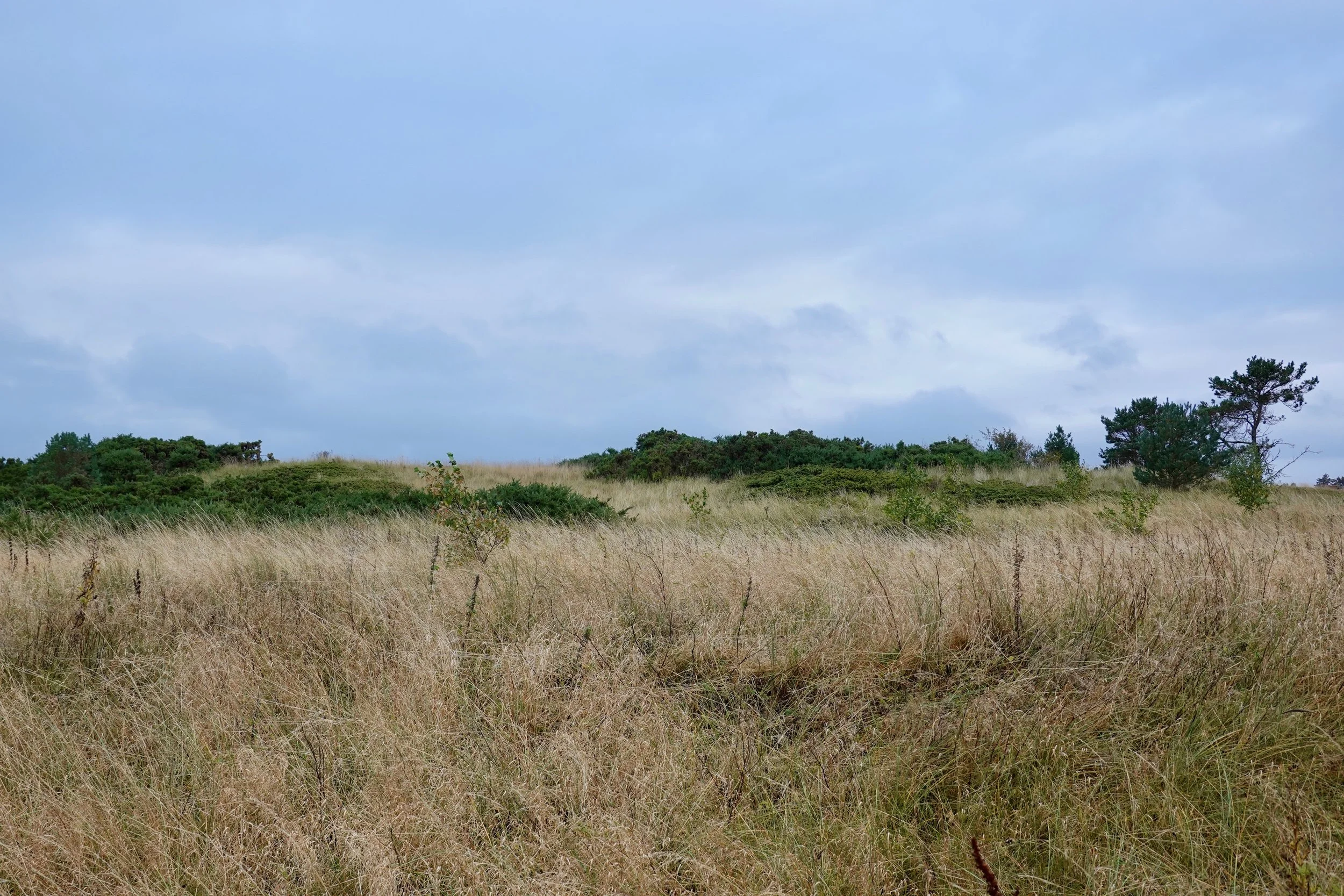
A stone’s throw inland from Dornoch Beach, the wind weaves through sand dunes large and small and through the dry, wispy grass.
When I visited Dornoch in 2016, the only time I’d left Cathedral Square had been to play golf. So after briefly walking uphill to lay eyes on the clubhouse, I wandered back down to the bottom of Golf Road. With the Square to my right and a few hours on my hands, I turned left and started walking toward the beach.
You can learn a lot about links land on that walk. About 250 yards from the shore, the sand begins moving: everything from dunes a few feet tall to ripples barely an inch deep. Over time, enough grass seed had blown in, little by little, grabbing a toehold and holding on just long enough to root; from there, enough grass grew up to hold the sand more or less in place. Thicken it up just a little, and 400 years ago, you would’ve had something that you could smack a rock around while your sheep got their fill.
I stood there for a long time, staring east, with the morning sun and and wind in my face. For 1,300 years, people had been standing where I was standing, feeling the same wind and squinting through the same sunlight on the same wet sand with the same dunes at their backs. Right there, all those years. Off to my left, golfers had been chasing balls and rocks around the links for 400 of those years. “How many?” I wondered. How many of them knew that they were walking on perhaps the greatest site for golf on Earth? How many of them fell in love with the place and longed to return as soon as life allowed?
And how many never did? How many golfers played at Royal Dornoch, not knowing that they were playing it for the last time that their life would allow?
. . .
“And now as I lie upon my bed
I pray I must be dreaming
With faces all around my head
And strangers at my door.”
- Lyle Lovett, “Baltimore”
As it turns out, having a morning to kill in Dornoch is not a bad thing. Back in town, I put away my existential musings and tackled Immaculate Grid over a latte and sausage roll at a delightful coffee shop called Milk & Honey. The only other customers were a young couple and their well behaved toddler daughter. While they talked, the little girl looked my way. I made a big smile and a cutesy wave — the kind that captivate babies but toddlers are tired of. What’s wrong with you?, her tiny dumbfounded face seemed to say. Can you name a Reds pitcher with a 200-strikeout season?, mine asked. Neither of us answered.
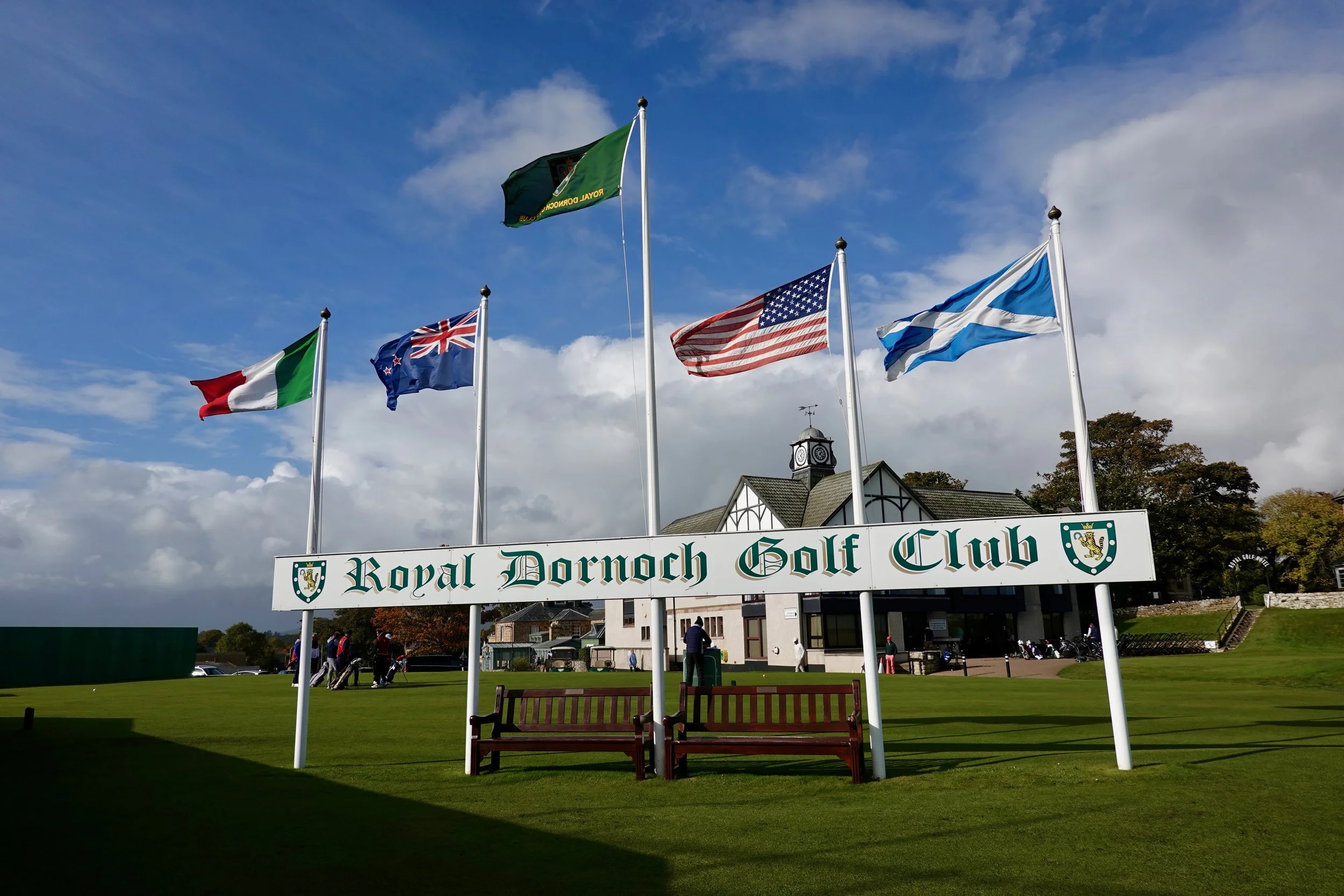
I know I’ve seen this place before.
I finished my sandwich and puzzle, then checked the time. Nearly close enough to my tee time to check in with the pro shop without shame, but still early enough to stroll. I thanked the waitress, slung my bag back across my shoulders, and headed back toward the links — past the Cathedral, past the hotel I’d stayed in eight years earlier, past the bus stop, and nearly past the tiny Dornoch Free Church. But a few steps past the small cemetery at the church’s rear, I stopped. I’d walked past it eight years earlier, too. This time, though, something gripped me. How many souls walk past this cemetery on their ways to and from the links?, I wondered. How many of those buried here did the same? And how many times will I have to see all that remains of them above ground?
I slid the bag off my shoulders again and left it at the cemetery’s gate. I didn’t feel right bringing it in; I don’t know why. The path led in toward the center of the yard, then branched off left and right. I walked in, turned right, wandered over to a row of headstones, and began reading wherever my eyes landed.
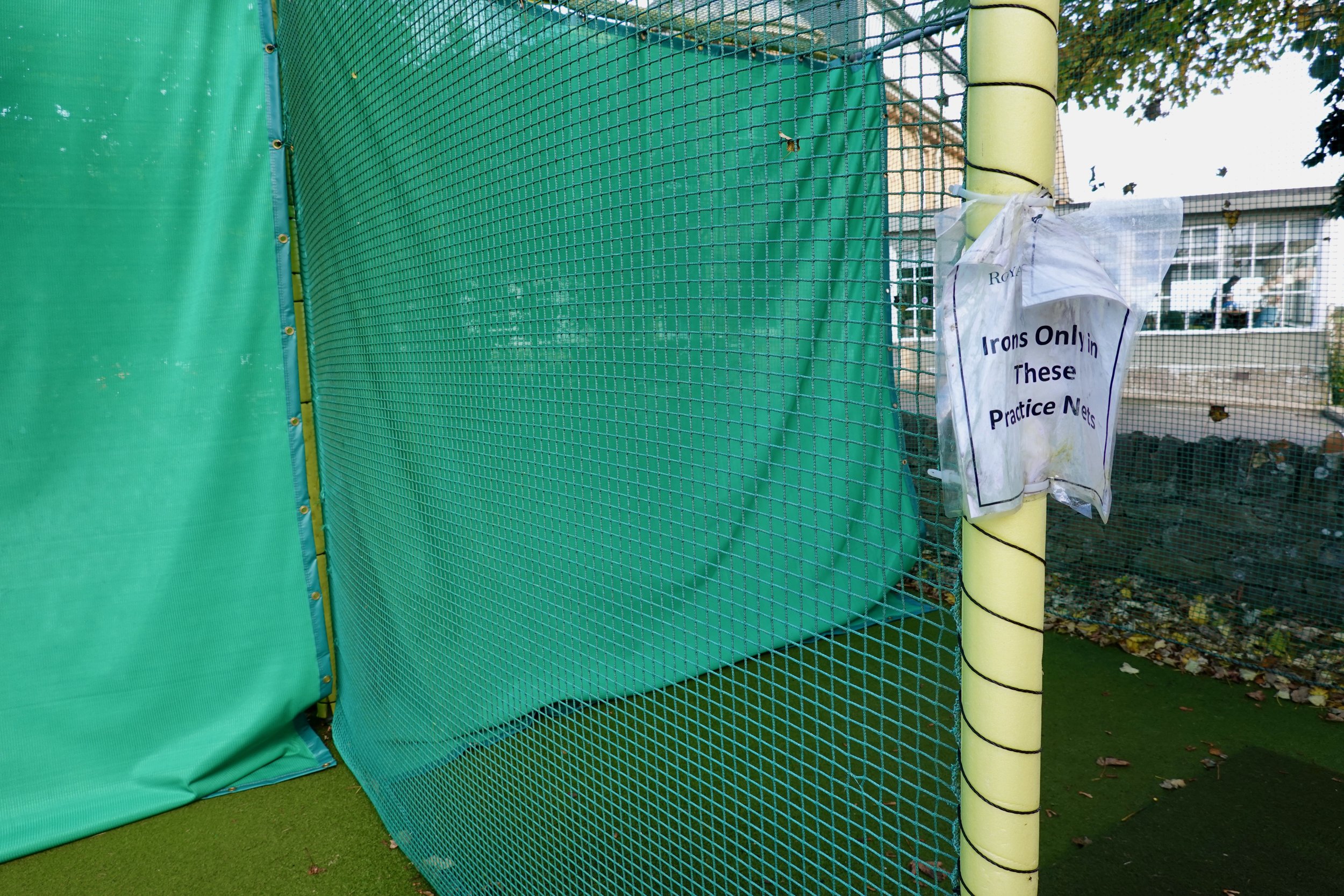
Royal Dornoch’s palatial driving range.
The fleetingness of life has no greater monument than a headstone. Beneath it lies a person — someone with a mother and a father, someone who loved and hated, someone who spent their years doing the best they could with whatever tools they’d been born with. Maybe they’d had children of their own. Maybe they’d had a home — not a house, but a home, where they felt in place. Maybe they had friends. If they were lucky, they’d felt happiness. Inevitably, they’d felt sadness. They had wept. They had been a person — flesh and blood, and all of it long since gone. That unique life, unlike any other before or since, reduced to a stone marker: their name, the day they were born, and the day they died. Maybe an epitaph. And that’s it. Their whole life: decades of love, hate, sadness, joy, family, friends — and nothing from it left above ground except a name and two dates chiseled onto a slab of rock that strangers wander past for the rest of time, with no idea of what happened in between the two dates carved thereon.
Henry Duff, a postman who died in 1922. Lieutenant Corporal Peter Gordon, either 21 or 22 years old, killed by Germans in northern France in 1917. Janet MacKay, born 1886, died 1890. Margaret MacKay Taylor, born 1896 with no electricity, died 1981, less than three months before MTV premiered.
Before them all, there had been Royal Dornoch. After, too. One day, it’ll be us, and Royal Dornoch will still stand. There is comfort in that, but also disappointment — Royal Dornoch will still be there, but just out of our reach forever.
. . .
“What makes the sun set in the west
And birds fly in the sky?
And what makes a woman beat her breast
When her children start to cry?”
- Lyle Lovett, “Baltimore”
If you wandered onto Royal Dornoch’s first tee by accident, you wouldn’t guess that one of the planet’s greatest golf courses lies ahead of you. It is an unassuming place: a straightforward par-4 (331 yards from the tips, 301 yards from the yellow tees) with a mostly flat green, and just enough fairway bunkering on the left to introduce players to risk-reward. The second hole is a memorable par-3 (184 yards from the tips, 167 yards from the yellow tees), with steep fallaways left, back, and right, and two sand traps ready to swallow anything short. But even there, the setting is reserved and earthly.
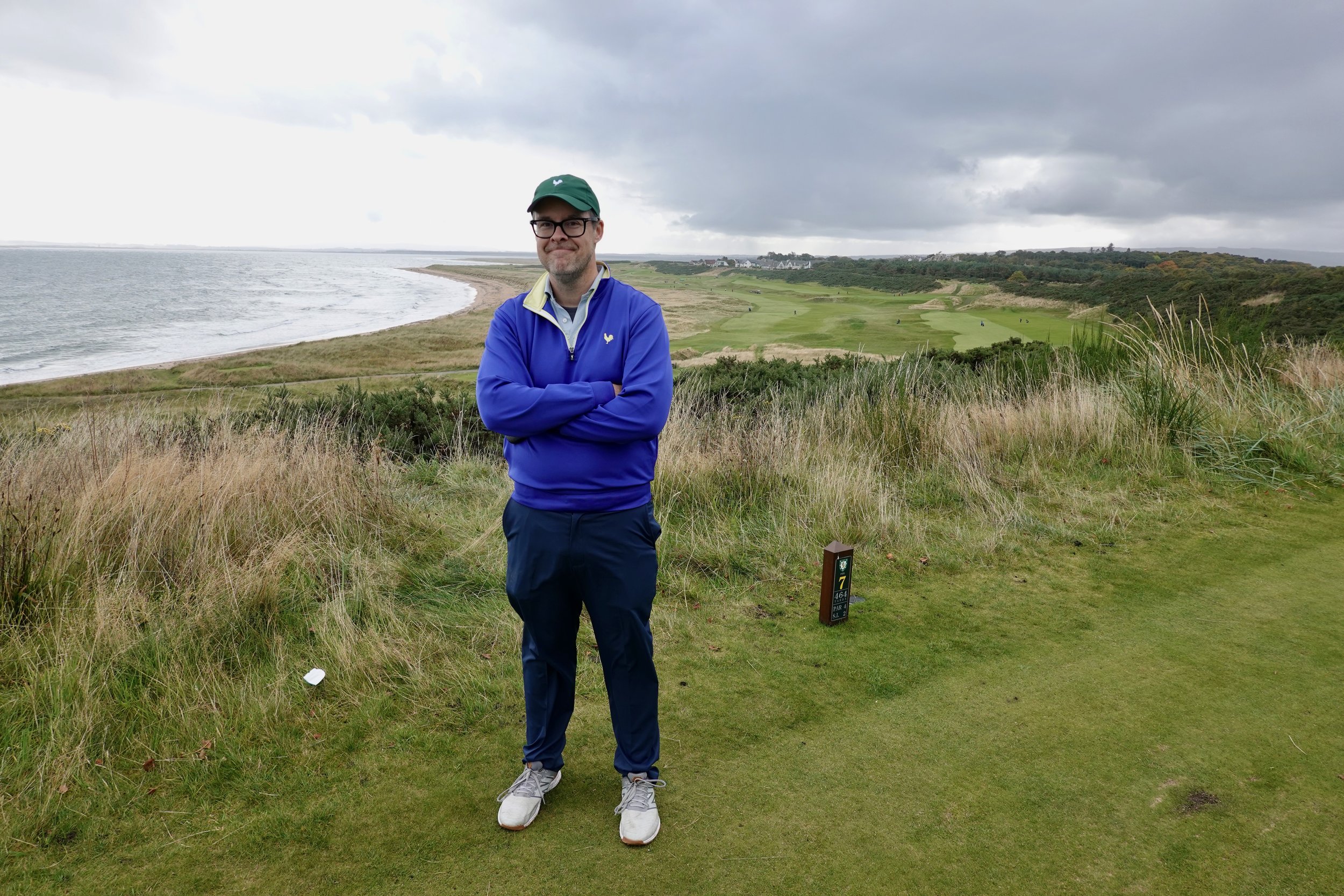
Your faithful blogger, figuratively and almost literally on top of the world at Royal Dornoch’s seventh tee.
Between the second green and the third tee, though, something magical happens. A path cuts through a thicket of gorse, with their bright green spines and yellow flowers like a hallway, just tall enough to block your view of what’s waiting. And finally, the path ends, and the full links opens in front of you. On a clear day, with the sun shining down from the sapphire-blue sky touching the Dornoch Firth on the horizon, it’s like seeing the world for the first time.
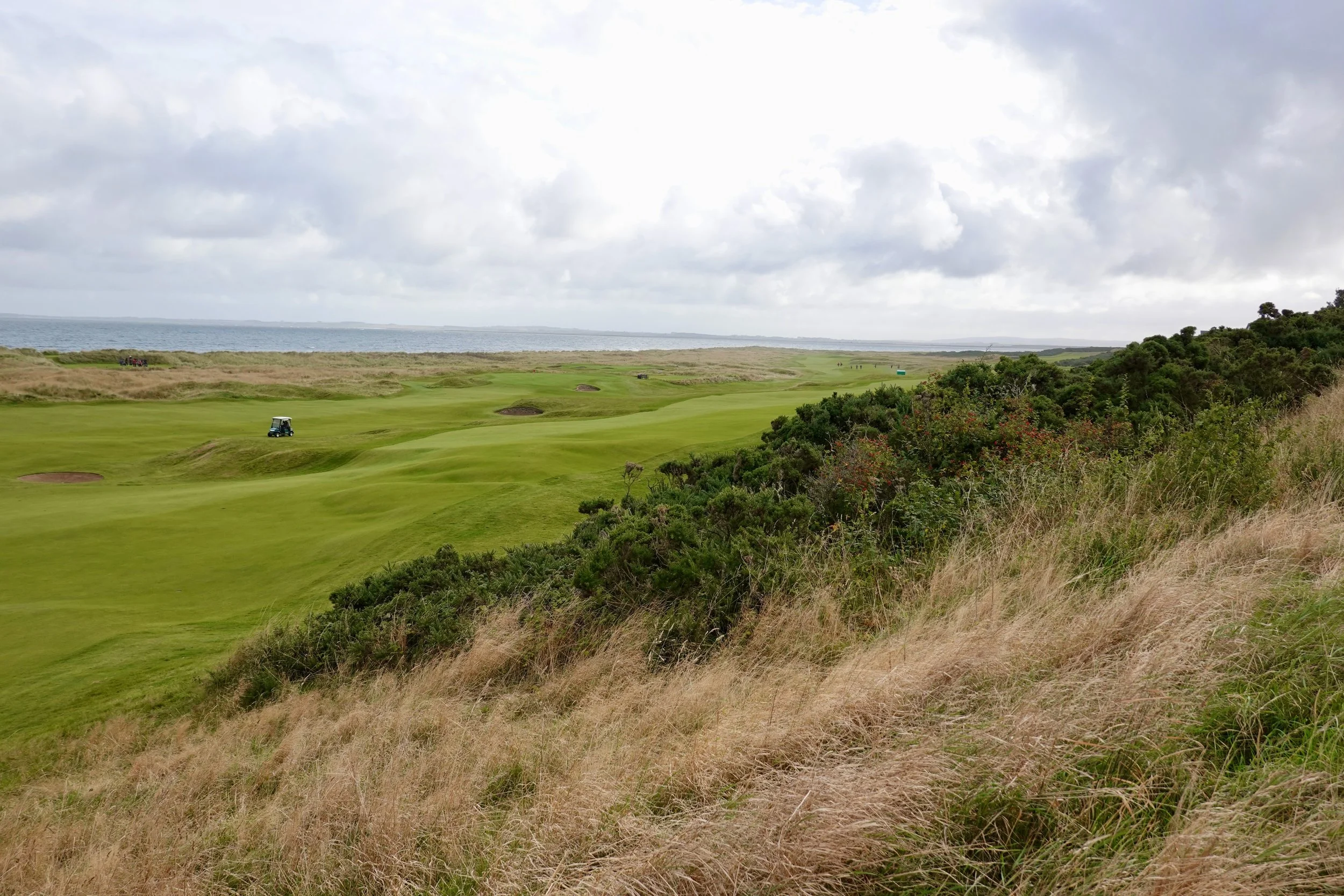
What is there to say about Royal Dornoch? It is a cathedral, and the third tee is its sanctuary. It sits perched at the top of a ridge, running northward above the beach. Beneath the ridge, the 15th hole runs back southward — and, from the third tee, nearly every hole in between is within view. It is the moment I’d come back to this place for, back to this country for. It had lost none of its power. It is the reason that I doubt I’ll ever return to Scotland without traveling back to the Highlands.
There’s an episode of “Peppa Pig” where she and her schoolmates visit a museum just before closing time. Mr. Rabbit, the museum director, leads them through the museum at a breakneck pace before dumping them back outside as politely as possible. Playing Royal Dornoch with a caddie isn’t quite that, but there is a sense of the round being more a curated tour than 18 holes of golf. They’re clearly trying to get you around as quickly as possible without being unceremonious — but you can’t complain, because Royal Dornoch is a museum: a time machine, at every moment showing players things they’ve never seen before.
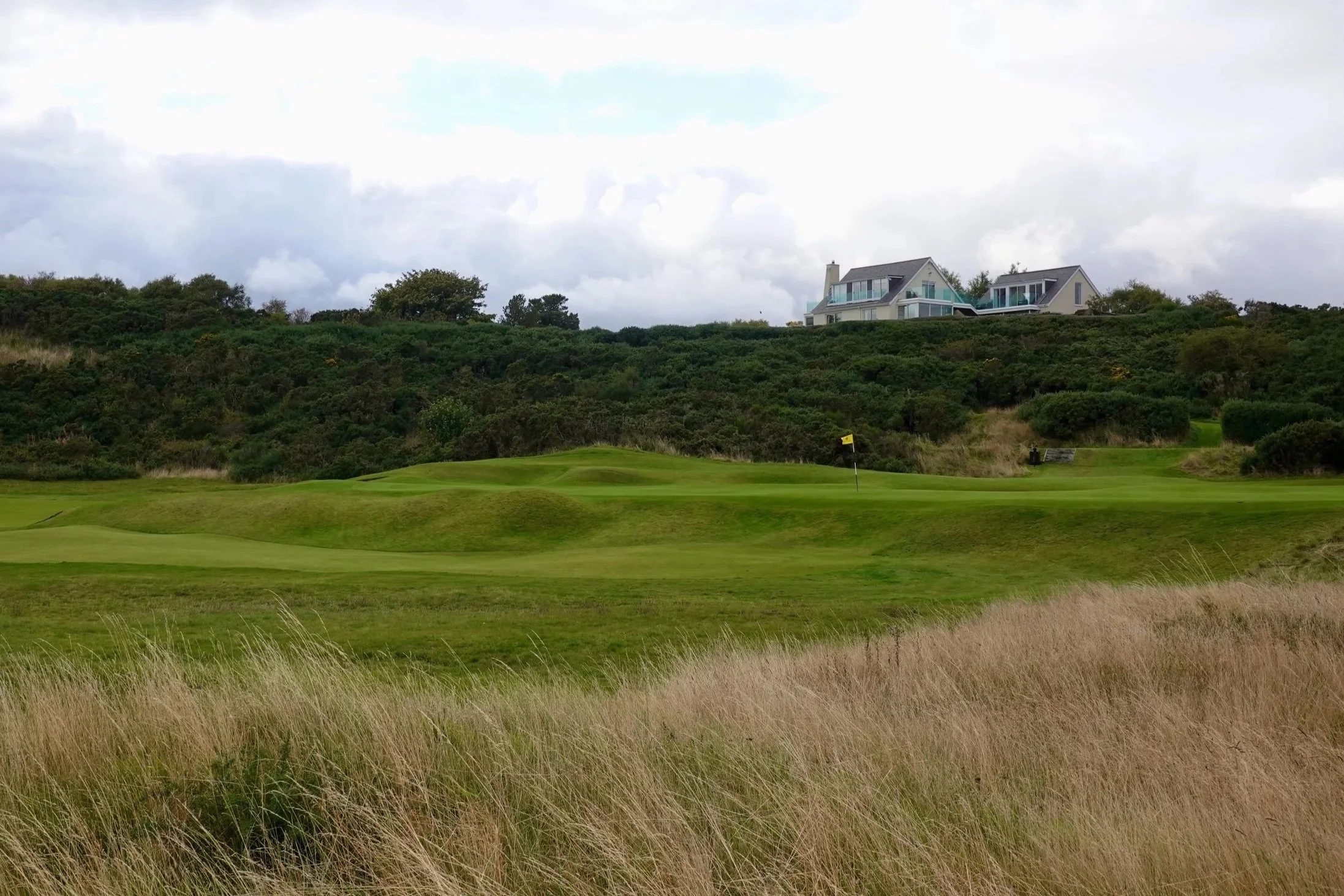
Royal Dornoch’s sixth green, seen here from the 12th tee.
There’s the par-3 sixth (161 yards from the tips, 156 yards from the yellow tees), my favorite on the course: built into the side of a hill, with three traps to the narrow green’s left and another short and right. But the wind blowing right-to-left from the sea is the biggest hazard of all: a draw over the right side of the green (and clear of that side’s only bunker) is the instinctive play, but any meaningful wind will bring the left-side bunkers dangerously into play. There’s the patience-testing eighth (482 yards from the tips, 421 yards from the yellow tees), with a split fairway that confronts players of nearly every length with a choice between a brutally difficult second shot, or a manageable layup to a third that’s probably puttable. The par-3 13th (180 yards from the tips, 148 yards from the yellow tees) is the picture of the razor-thin margin between success and failure: a long green surrounded on nearly all side by bunkers ready to swallow anything on the green’s edges, but with an interior that slopes toward the green’s center, rewarding any shot that escapes the traps. And then there’s the long par-4 14th (445 yards from the tips, 439 yards from the yellow tees): a bunkerless double-dogleg with mounds sticking up their heads throughout the fairway, where the the test is simply staying in position and hitting smart shots.
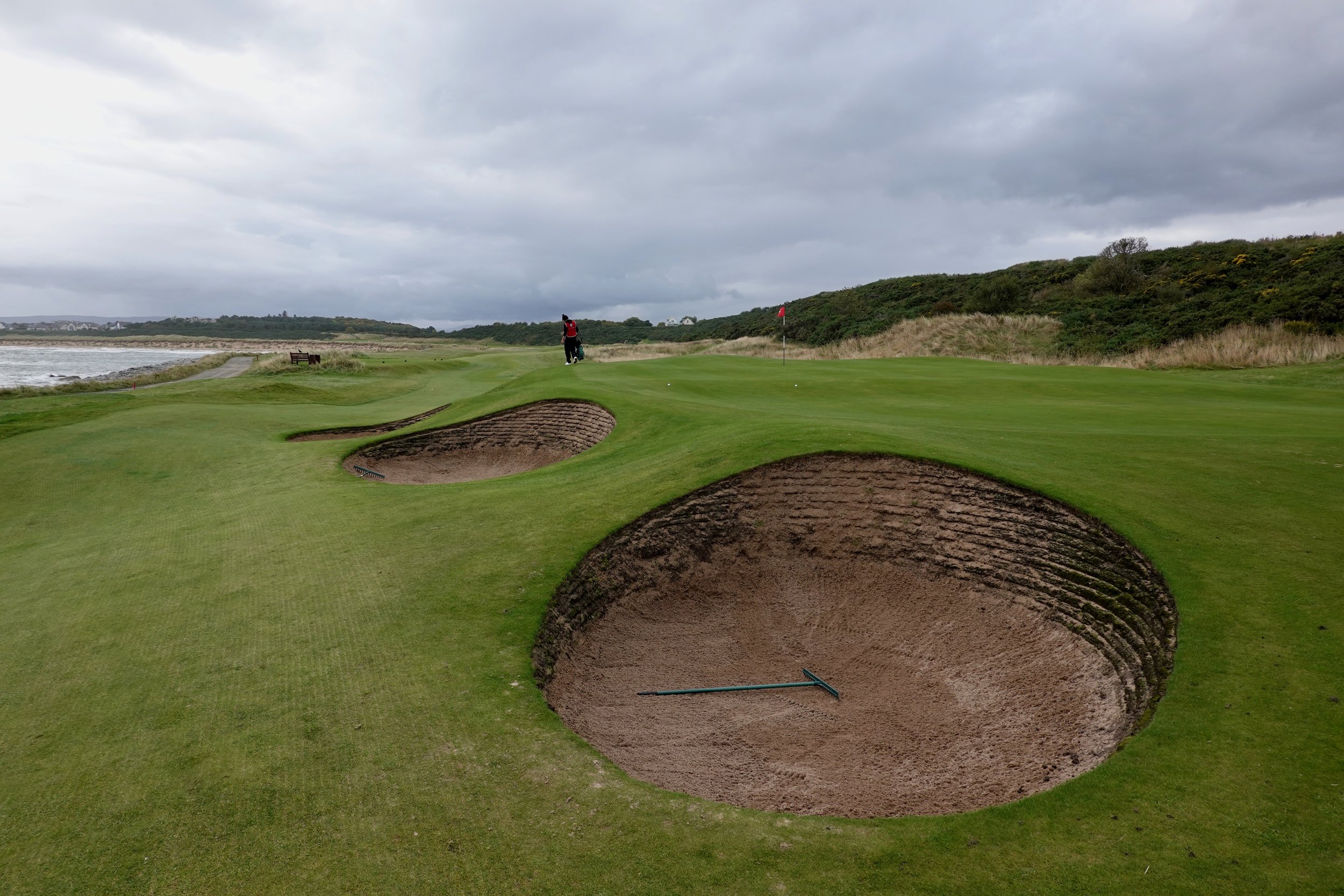
What the par-3 13th hole gives players in short yardage, it takes away in a dangerous target: a narrow green surrounded by seven bunkers, including these three on the left side. Squint hard enough and you’ll see your faithful blogger’s green in regulation.
For all Royal Dornoch’s accolades, it is ultimately a design that champions classic design principles without getting in the way of the land’s natural features. Nearly every hole presents options that are aggressive, conservative, and something in between: choices between danger and safety, with rewards and consequences for whatever choice the player makes. Lord knows it’s not the only course in Scotland that accomplishes that, but I’ve yet to find another that shows so emphatically that minimalism doesn’t have to be boring.
I don’t remember what I shot. I remember a handful of great moments: a par on No. 2; the 8-iron of my life into the par-3 10th (174 yards from the tips, 142 yards from the yellow tees); and a long, curling putt from short and left of the green at the par-4 17th (417 yards from the tips, 390 yards from the yellow tees) that nestled next to the hole to set up a par save. And I remember walking up the 18th fairway with the October sun settling in behind the town off to my right. Not exactly a perfect-timing sunset finish, but closer than most of us get in our lifetimes.
. . .
“And what makes those little ones grow old
To find eternity?
And what takes the wise and leaves behind
A foolish one like me?”
- Lyle Lovett, “Baltimore”
A small table in the corner of the dining room was exactly where I wanted to be. I slipped gingerly into the chair and ordered a cheeseburger and an Ardbeg. The burger I inhaled. The scotch I nursed. Ardbeg is my favorite scotch, and if Royal Dornoch isn’t my favorite course in the world, it’s probably my favorite place. I was going to exist with them both for as long as I could.
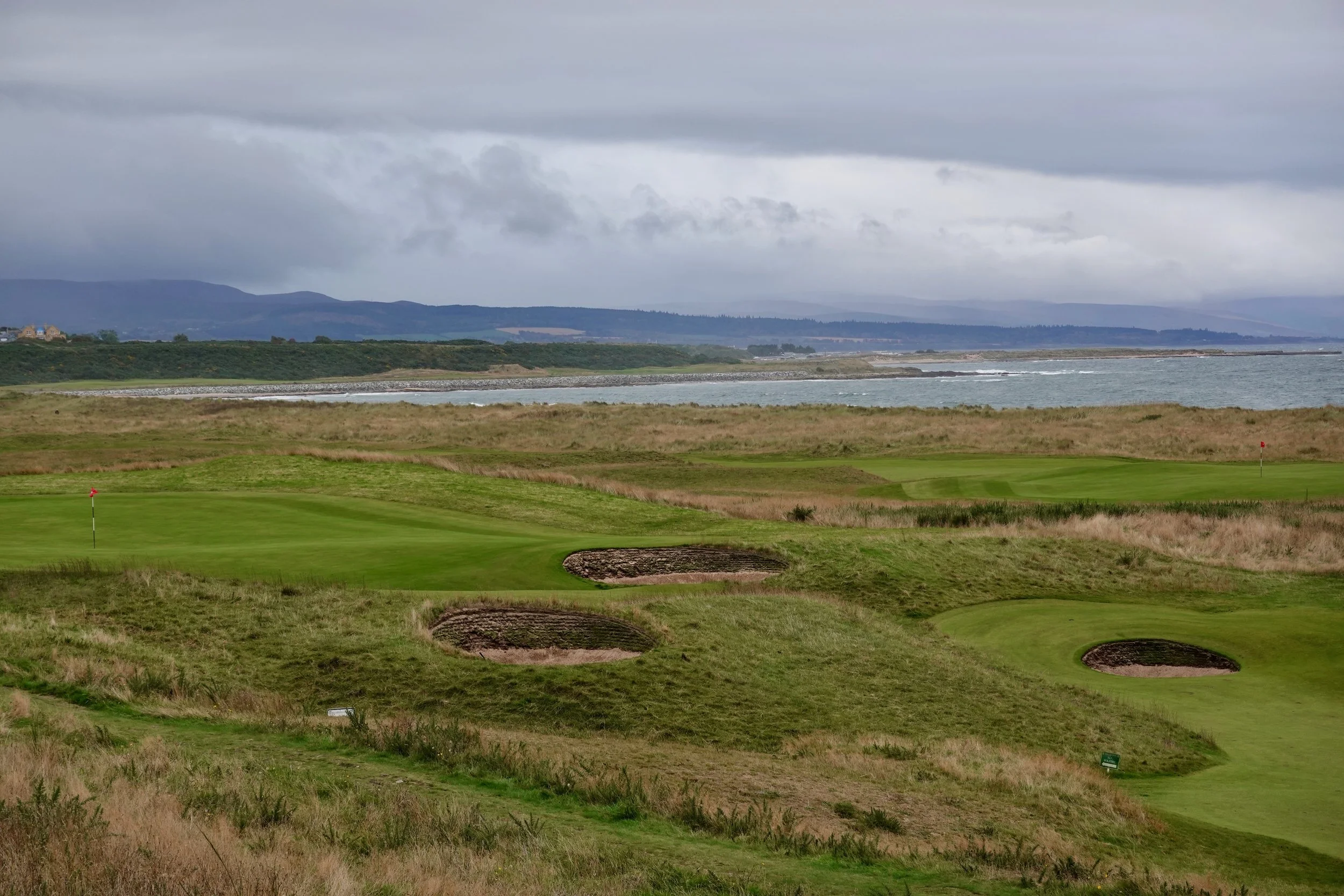
If there’s a golf course anywhere in the world that shows itself off while you wind your way through a round, then I haven’t found it.
I scanned the room while the scotch singed my throat and filled my head with peat and smoke. Near the bar, a faux-businessman American was trying to recruit a half-dozen local caddies to his home club, back in Dallas or Fort Lauderdale or some other concrete apocalypse, where he assured them that they could make more money than they were making here. On the other side of the room, a group of locals talked back and forth at a volume somewhere between rowdy and broken muffler. When I’d planned this trip months earlier, I’d imagined myself spending my nights in pubs or rooms like this, chumming it up with new friends and slugging back one too many drinks. I’d had it all wrong. This moment, with just me and my scotch in the Royal Dornoch clubhouse, was what I really wanted.
God, I hope it wasn’t my last time.
The sun sets early in the Highlands in early October. With the golf course set on the east side of Dornoch, there is no brilliant sunset; the sun settles behind the west side of town, beyond view; and the glow on the golf course slowly dims until the world is black. From my seat in the dining room, I squinted through the windows, trying to catch a last glimpse across the first fairway, toward the 18th green. Within a few minutes, though, dusk turned to dark, and it was gone. The day had been short — barely enough for a walk around town, 18 holes, and an hour to reflect on it all.
And not just for the Highlands in October. Young or old, our days grow shorter. There are not enough of them for all the days we deserve at Royal Dornoch.
. . .
You might also enjoy reading…